RUTH CHASE ON FINDING LIGHT IN THE MYSTERY
Joseph E. Morgan | September 3, 2026
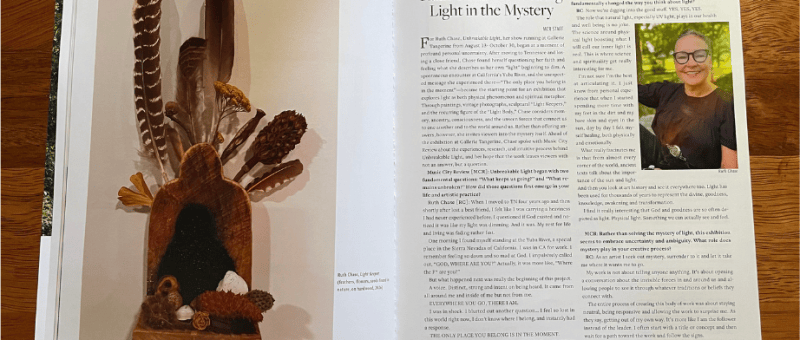
For Ruth Chase, Unbreakable Light, her show running at Gallerie Tangerine from August 13- October 30, began at a moment of profound personal uncertainty. After moving to Tennessee and losing a close friend, Chase found herself questioning her faith and feeling what she describes as her own “light” beginning to dim. A spontaneous encounter at California’s Yuba River, and the unexpected message she experienced there—“The only place you belong is in the moment”—became the starting point for an exhibition that explores light as both physical phenomenon and spiritual metaphor. Through paintings, vintage photographs, sculptural “Light Keepers,” and the recurring figure of the “Light Body,” Chase considers memory, ancestry, consciousness, and the unseen forces that connect us to one another and to the world around us. Rather than offering answers, however, she invites viewers into the mystery itself. Ahead of the exhibition at Gallerie Tangerine, Chase spoke with Music City Review about the experiences, research, and intuitive process behind Unbreakable Light, and her hope that the work leaves viewers with not an answer, but a question.
Music City Review [MCR]: Unbreakable Light began with two fundamental questions: “What keeps us going?” and “What remains unbroken?” How did those questions first emerge in your life and artistic practice?
Ruth Chase [RC]: When I moved to TN four years ago and then shortly after lost a best friend, I felt like I was carrying a heaviness I had never experienced before. I questioned if God existed and noticed it was like my light was dimming. And it was. My zest for life and living was fading rather fast.
One morning I found myself standing at the Yuba River, a special place in the Sierra Nevadas of California. I was in CA for work. I remember feeling so down and so mad at God. I impulsively called out, “GOD, WHERE ARE YOU?” Actually, it was more like, “Where the F* are you?”
But what happened next was really the beginning of this project.
A voice. Distinct, strong and intent on being heard. It came from all around me and inside of me but not from me.
EVERYWHERE YOU GO, THERE I AM.
I was in shock. I blurted out another question… I feel so lost in this world right now, I don’t know where I belong, and instantly had a response.
THE ONLY PLACE YOU BELONG IS IN THE MOMENT.
As I am telling you this I am sitting outside and a hummingbird is flying around me.
Basically, this is where it all started.
MCR: The press release notes that your research has taken you through religion, science, personal experience, and different cultures. Were there any particular discoveries or traditions that fundamentally changed the way you think about light?
RC: Now we’re digging into the good stuff. YES, YES, YES.
The role that natural light, especially UV light, plays in our health and well being is no joke. The science around physical light boosting what I will call our inner light is real. This is where science and spirituality get really interesting for me.
I’m not sure I’m the best at articulating it. I just know from personal experience that when I started spending more time with my feet in the dirt and my bare skin and eyes in the sun, day by day I felt myself healing, both physically and emotionally.
What really fascinates me is that from almost every corner of the world, ancient texts talk about the importance of the sun and light. And then you look at art history and see it everywhere too. Light has been used for thousands of years to represent the divine, goodness, knowledge, awakening and transformation.
I find it really interesting that God and goodness are so often depicted as light. Physical light. Something we can actually see and feel.
MCR: Rather than solving the mystery of light, this exhibition seems to embrace uncertainty and ambiguity. What role does mystery play in your creative process?
RC: As an artist I seek out mystery, surrender to it and let it take me where it wants me to go.
My work is not about telling anyone anything. It’s about opening a conversation about the invisible forces in and around us and allowing people to see it through whatever traditions or beliefs they connect with.
The entire process of creating this body of work was about staying neutral, being responsive and allowing the work to surprise me. As they say, getting out of my own way. It’s more like I am the follower instead of the leader. I often start with a title or concept and then wait for a path toward the work and follow the signs.
Mystery is where all the juicy stuff lives, at least from my perspective.
MCR: Vintage photographs appear throughout the exhibition, creating what you describe as a bridge between past and present. What stories or emotions do these found images allow you to explore that painting alone cannot?
RC: I started painting from vintage photographs back in the ’80s. There is something about staring at an old photograph, especially trying to capture the life lived in someone’s eyes, that has always interested me.
I find myself wondering what we inherit from the people who came before us, especially our ancestors. But I’m also curious about time and this idea that time isn’t as linear as we experience it. What does it mean if the past and present are somehow more connected than we can see with our eyes?
There is some fascinating research from Rupert Sheldrake and his theory of morphic resonance. His work carried on the work of William McDougall, who conducted experiments with rats learning to navigate a water maze. The idea was that as generations of rats learned the maze, later generations seemed to learn it more quickly. Sheldrake questioned whether information could somehow carry forward beyond what we understand through genetics alone.
I can only talk about this from a pedestrian point of view. But that’s what comes up for me when I work with old photographs. I wonder what we carry with us from the people who came before us and what might be there that we simply can’t see.
MCR: The “Light Body” returns in this series as a companion, guide, and ancestral presence. How has this figure evolved since its first appearance in your work?
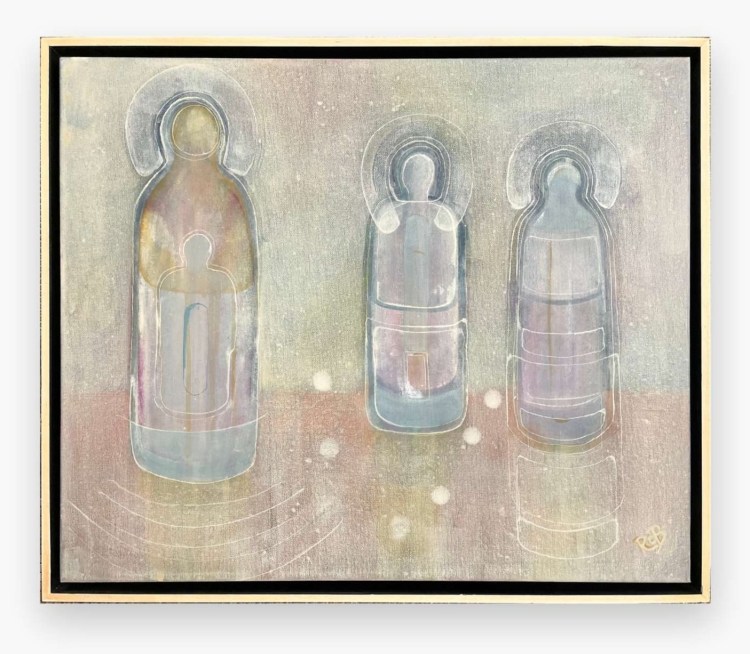
RC: Well, at the age of seven, a large ball of white light appeared at the end of my bed while two figures wrestled to keep it contained within the space of my room. I sat up in bed, wide eyed and curious, watching these ambiguous light figures seemingly trying to contain this massive, compacted ball of light. This happened several times when I was a child.
That experience stayed with me, of course. Last year I made my first painting, Waking in the Light, trying to capture what those figures might have looked like. As I was painting them, the words “Light Body” came to me. So that is what I call them.
From there the Light Body became a symbolic icon in my work. Over time the figure has evolved into something much more simplified, almost like the outline of a Russian nesting doll.
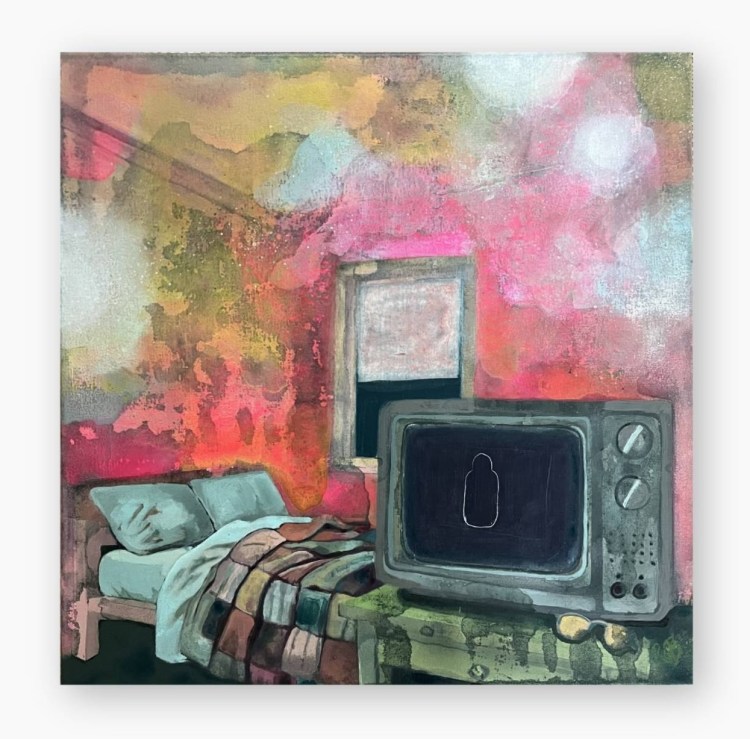
You can see that most recently in The Only Place You Belong Is The Moment, where the Light Body appears inside a TV set.
MCR: The exhibition introduces the Light Keepers, sculptural vessels containing found objects and personal treasures. How do you decide which objects carry enough emotional or symbolic weight to become part of these works?
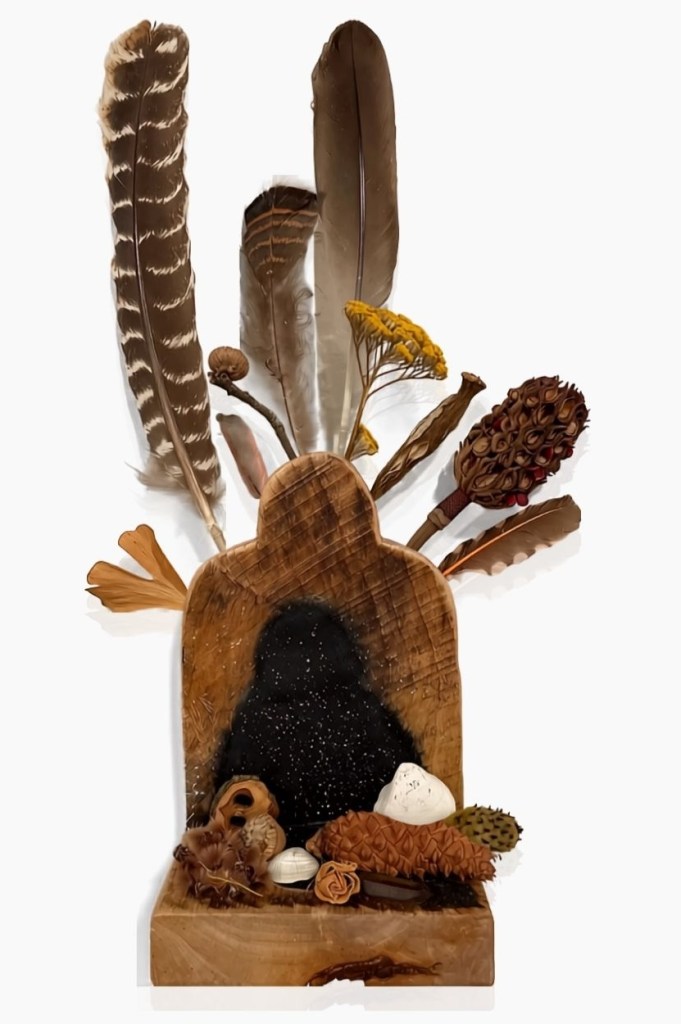
RC: The Light Keepers are wall sculptures of Light Bodies. This idea came to me as a place to collect things from walks in nature. In essence, they are about bringing light back into your home.
For me, nature holds a lot of light. The ephemera that find their way into the sculptures are things that caught my attention and became offerings of light uniquely adorning each sculpture.
These objects are intentionally meant to be replaced and changed over time. So the Light Keeper is really an evolving work in progress.
MCR: You describe the exhibition as “a collection of meditations disguised as art.” What do you hope viewers notice—or perhaps feel—when they spend time with these pieces?
RC: Let me answer that question by starting here: after the first two hours in the studio, music blaring, no devices and no Wi-Fi allowed, a haze of thoughtlessness comes over me. You know, the flow state. The thinking part slows down, I’m working towards a theta brainwave, the same wavelength that comes in meditation or prayer….. then the language of impressions starts to culminate into symbolism. I start letting go of control over what I think I should be doing.
I’m not alone in this. I think this is what most artists experience.
As for what the viewer feels, I’m detached from that.
If I have a hope, it’s simply that the work makes them feel something, contemplate something or stimulates an inner dialogue.
If the work can do that, I think it has done its job.
MCR: Your work often moves between imagination and physics, the visible and the invisible. Do you see art as a bridge between those worlds, or as something entirely different?
RC: Oh, great question.
I suppose I do see art as a bridge. Maybe they are not really separate worlds at all.
Art seeks to understand the world and science seeks to explain the world. Right? They may use very different languages but both are asking questions about what is here, how it works and what it all means.
I remember one of my professors in college saying that artists were in the same field as theologians, scientists and philosophers because we were all in the pursuit of truth. That really stuck with me.
MCR: You currently serve as Regional Arts Director at Monthaven Arts and Cultural Center. How do you balance the responsibilities of arts leadership with the solitude and introspection that your own artistic practice seems to require?
RC: The life of an artist, I hold two jobs and am in the studio fulltime. It took me many years to learn how to keep it together between curating and my own studio practice. I have to be able to bounce back and forth between them. They require different things from me.
I’ll schedule my museum work for a full week, no studio time and then switch to studio time for two weeks exclusively.
When I’m working for Monthaven or for HUṠWEJ, my CA gig, I mostly stay out of my studio. Likewise, when I’m in the studio, I put everything else aside. I need that uninterrupted space to go deep into the work.
I’ve learned that I can’t really do both at the same time. I have to fully inhabit one and then fully inhabit the other. Kinda like breathing.
MCR: As audiences encounter Unbreakable Light this fall, what conversations do you hope the exhibition sparks about memory, consciousness, and the unseen forces that shape our lives?
RC: My hope is that the work inspires people to wonder about things, ask questions and remember things… things, ha ha.
When I say remember, I am referring to knowledge that can be remembered through symbolism. Something that is helpful or guides them. It’s so hard to know how someone else will experience the work. Perhaps the artist is the last person to know.
Hummmmm… you know, I hope people can trip out a little. Let go and let their imaginations expand. Maybe have a moment of inspiration or find a sense of possibility, hope or even excitement about life beyond what we can see or think we know.
I don’t really need them to come away with an answer. I’d much rather they leave with a question or a feeling that makes them curious.
For Chase, it seems that Unbreakable Light ultimately circles back to the revelation that began it: “The only place you belong is in the moment.” What began as a personal crisis became an extended investigation into light, memory, faith, science, and the invisible connections that shape our experience of the world. At Gallerie Tangerine, those questions take physical form, but they remain deliberately unresolved. Chase does not ask viewers to accept a particular belief so much as to slow down, look inward, and allow themselves to wonder. If the work succeeds on its own terms, visitors will leave not with an answer, but with a little more light—and another question to carry with them.
Joseph Morgan is a father of two, husband, teacher and recovering guitarist in Middle Tennessee.

